Listening Zone: Click on the names below for a link to hear these great trumpet artists play. Pay particular attention to their tone quality.
Thoughts and Ideas
Here’s a GREAT idea!
This is a terrific idea from Joey Tartell of Indiana University. You can find more at
https://joeytartell.com
Smart(phone) Practice
September 1, 2017
The school year has started. For a lot of you, that means back to lessons and ensembles, with a whole lot of new music for you to prepare. When preparing music, you need to pay attention to detail, work out the technical and musical challenges, and make sure you’re playing your instrument fundamentally well.
Don’t forget to practice performing!
Too often musicians spend so much time preparing a piece, they leave performance out of their practice. Once the piece has been studied, the “hard parts” are worked out, and the phrasing has been decided, the practice session ends. There needs to be one more step.
Practice performing the piece.
How, you might ask? Good question. For those of you with smartphones (and I think that’s a lot of you), try adding this to your daily practice.
1 After the “normal practice” of your piece, put your phone on your music stand, and video record a performance of the piece.
2 DON’T WATCH IT YET!
3 When you are ready to practice this piece next (at least one day later), watch the video.
4 Notice what you did well, as well as what needs work. Delete the video.
5 Repeat steps 1-4.
Adding this to your daily practice gives you the opportunity to show yourself exactly what others see in your performance. That’s why you don’t watch the video immediately. When you give yourself that day, something that you might have not noticed could stick out, while something else that bothered you in the moment might be no big deal. You might also notice aspects of your performance that you hadn’t considered before (posture, hand position, funny faces that you make while playing).
Since you are the only one watching the recordings, it’s up to you to be completely honest with yourself. If not, it’s like cheating at solitaire- sure you may have “won,” but who cares? Holding yourself accountable for daily performance can certainly be frustrating, especially at first. Done correctly, you’re gaining valuable performing experience that will have you better prepared when you next step on stage.
How our focus determines the focus of the audience
Here is a short section from the Instrumentalist magazine.
Barbara Butler, July 2010
I found out years ago that musicians can actually control how an audience thinks about the music. At a lesson a student played a piece for me and sounded great, but part way through it I realized my mind had wandered. I was embarrassed and simply asked him to start over without explaining why. He replied, “I’d love to start again. I was really into it until the double bar.” This surprised me because it was at the double bar that my mind started to wander.
Later that week at a group lesson, I experimented and played a lyrical piece in three sections for them. In the first section I focused on playing as though I were an opera singer who brought meaning to every word in the lyrics. During the second section I thought only about my trumpet technique, while during the third section I thought only about going out to dinner. After I finished I asked which section they liked best, and every single person chose the first section, describing it as singing and beautiful, almost like a dream. About the second section they commented about the clean tonguing and neat slurs; all comments pertained to my technique. About the third section there were so few specific comments because their minds had wandered just as mine did. From that moment I learned that a performer can control how the audience thinks about and reacts to the music. If you teach music solely by emphasizing notes and technique, no one will be thrilled by the result.
To buzz, or not to buzz…
The Home Practice Starter Kit
Many thanks to Brian Switzer at burlingamemusiclessons.com for this great article!
The Home Practice Starter Kit:
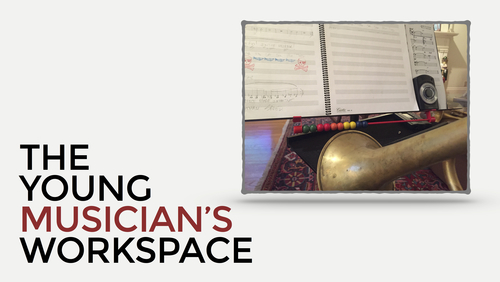
Lesson House Stand: Notice the deep shelf, metronome, tray for pencil, reeds, rosin, valve oil, and the colorful beads that help younger students stay on track when performing a selection ten times in a row.
- A quiet area away from the commotion of daily household activities
- Posture promoting chair for music practice
- Nice, sturdy music stand
- Tray for supplies that attaches to the music stand
- Metronome & Tuner
- Pencil
1. A QUIET, DESIGNATED PRACTICE AREA
Playing a musical instrument takes incredible amounts of concentration. It is not easy for young players to coordinate their minds, fingers, bodies and embouchures as they do their best to interpret new symbols and abstract musical concepts. It is darn near impossible to practice in the family room while siblings watch TV or come in and out heading off to soccer practice with the dog running around and Mom and Dad trying to coordinate the evening’s schedule while preparing a meal and helping with homework. Find an area in the house, even if it is the corner of a calm common area, where your music student can go to each evening and experience an uninterrupted period of musical concentration. Don’t be surprised if after a while, you notice your musician retreating to the practice area and pulling out his instrument without you having to tell him to. Practicing an instrument can be relaxing and cathartic and is filled with innumerable moments of intrinsic reward. Help your student find a happy place by providing a designated practice area.
2. POSTURE-PROMOTING CHAIR FOR MUSIC PRACTICE
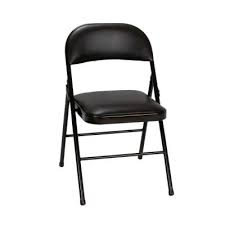
This is picture of a chair. LOL
Once you have designated the practice area, mark the territory with a posture-promoting chair. I remember being a kid and sitting on the couch or on my bed and trying to play my trumpet. It just doesn’t work! The stomach, back and torso muscles are all critical in helping to support the body and expel the air in a controlled, efficient manner. It doesn’t matter the instrument–woodwind, brass, strings, guitar, piano, you name it–a sturdy chair helps the student sit up properly and develop good habits. Students who have a decent practice chair will carry their posture-perfect habits forward into school rehearsals and other extracurricular musical groups. I can’t tell you how often the band director has to remind the class, “Everybody sit up straight!” Don’t let the band director aim this command at your student. Instead, help set an example by providing a nice, functional chair designated for daily musical practice. The chair pictured is great because it can be folded and stored behind a bedroom door.
3. NICE, STURDY MUSIC STAND
Chances are you have seen your kid do this or you did it yourself when you were in school music. Picture it: kid gets a new band piece and is totally excited to take a crack at it at home. Opens up case and puts together instrument. Spends next ten seconds attempting to balance a single sheet of music in the open case only to have it fold over after playing only a few notes. Stop playing. Fix music. Repeat.
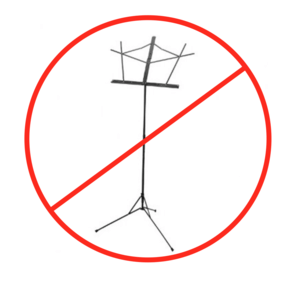
While this stand is great for gigs and rehearsals where the musician must bring a stand, there are much better options for home practice.
When I finally got my first nice music stand, my practice sessions improved immediately. I spent my time actually practicing rather than fussing with my music every minute. Parents, please get a nice stand with a deep shelf that will allow your student to place books, single sheets of music, a metronome, a tuner, pencil, etc. on the stand. I do not suggest the wire metal folding stands pictured. The shelf is not very deep or level and the music falls to the ground constantly. It also lacks a solid back, so the metronome will inevitably fall backwards and the battery will fall out. Sound familiar? If you are a musician this has definitely happened to you.
I’ve also heard students say they place their music on the piano as they practice. This is not ideal as it forces the player to adjust his playing position to the location of the music. Ideally, the student should sit in the proper position and adjust the music and stand accordingly. The piano is a musical instrument, not an incredibly heavy and expensive music stand.
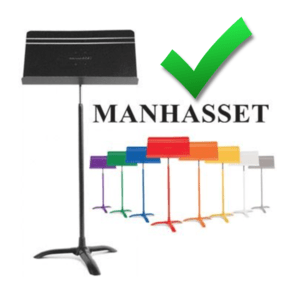
Get a nice, solid, stay-at-home music stand and erect it in front of your posture-promoting music chair in your quiet, designated practice area. Manhasset is the industry standard found in nearly every band room in the country. A nice stand will help your student make the most out of the music education being provided. Guaranteed!
4. TRAY FOR SUPPLIES THAT ATTACHES TO MUSIC STAND
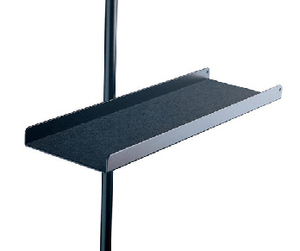
Musicians often have supplies that are necessary for quality music making. Valve oil, reeds, rosin, tuner, metronome, etc. Most music stores sell little trays that attach, via a clamp, to the music stand. This will allow your musician to keep all of his musical belongings in one tidy area. Think of the music stand as the musician’s office desk. When I play in the orchestra pit of a musical, nearly every musician in the ensemble has a little tray attached to the stand. You don’t need to be a pro to pick one up and let it change your life for the better!
5. METRONOME & TUNER
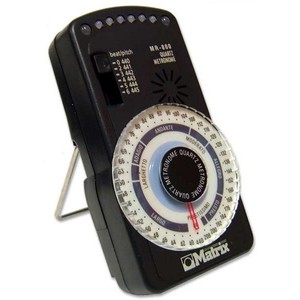
While the iPhone has plenty of metronomes available I am not in support of metronome and tuning apps. The last thing I want students doing while they practice is to have yet ANOTHER reason to interface with their phones. Please get a metronome and tuner from a local music store and place it on the stand.
I recently saw a show on PBS highlighting the talent in the San Francisco Symphony Orchestra. At one point they showed a few seconds of a flute player practicing at home. I had to laugh when I heard the metronome ticking away in the background.
It cannot be stressed enough how important the metronome is to the music making process. Approximately 80% of each private lesson is played with a metronome. I then write tempo markings on every musical selection and exercise for home practice. By executing musical muscles at the exact same speed repeatedly, the mind is asking the body to process complex information at precisely the same interval per attempt. Eventually, this will make things much easier as the musician is dialing in how to perform the exact same task successfully, rather than having to expel needless energy and concentration adjusting for variables.
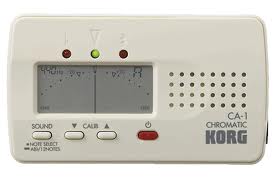
Needless to say, a metronome also helps musicians develop an innate sense of time and rhythm which is crucial for quality music making. It is said that the majority of disqualifications during auditions for symphonies are due to imperfections in rhythm. I could go on and on and on about the importance of a metronome.
The tiniest change in embouchure or posture can greatly affect the pitch of a given note. It is paramount that students learn to play in tune at an early stage in their music making. I have found that developing players are able to see the light reacting to their pitch much more clearly than they can hear the minute differences in intonation. With time, however, students learn to hear what they are seeing. The tuner is an essential tool and all students must check their pitch throughout home practice sessions.
6. PENCIL
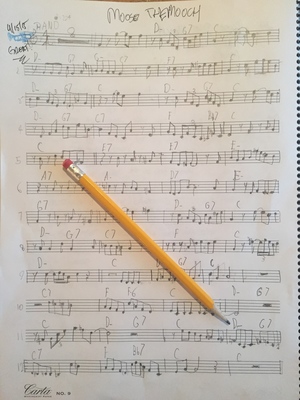
Example of student work by an 8th grade sax player.
Make sure your student has a pencil handy so he can capture his imagination during home practice! Musical notation is complex and quite often musicians need to jot down notes and reminders on the music. Sharps, flats, fingerings, tempos and rhythms are all things that we must make notes about from time to time. When I practice I often think of things that would never cross my mind otherwise and like to have a pencil handy to jot them down.
Students are required to write out musical selections each week as part of their at home development. As students become comfortable with musical nomenclature they inevitably will want to preserve their own musical ideas when inspiration strikes. Help your young musician succeed by making sure a pencil is handy. So simple, yet so essential!
My Teaching Philosophy
Over my 30+ year teaching career I have taken interviews for a number of positions ranging from junior high band director to professor of trumpet at a major university. During many of those interviews I have been asked to expound on my teaching philosophy. While it’s easy to toss out a terse prepared statement using the latest educational buzzwords to hopefully satisfy a over stressed interview committee, putting a useful and truthful statement of philosophy together can be a daunting endeavor.
I happened across a chapter in a book by Frank G. Campos, Professor of Trumpet at Ithaca College. The book is titled “Trumpet Technique” and one of the final chapters is called “A Letter to My Students.” I can think of no better statement of teaching philosophy.
A Letter to My Students
Teaching the trumpet is a difficult task. The development and refinement of high-level psychomotor skill is a slow and frequently frustrating process. We teachers rely on our personal experience, training, and intuition to solve the problems that come into the studio each day. Every student has a unique pattern of physical and mental characteristics that must be explored and understood in order to properly prescribe workable solutions for the obstacles that halt forward progress. Not every ailment has an immediate solution, and a diagnosis may be a shot in the dark until more is known. For most situations, patience is the order of the day. The ability to demonstrate on your instrument the desired musical product, even without uttering a single word of instruction, is generally regarded as an extremely important qualification of a fine teacher, but not every artist can teach. How we choose to teach is every bit as important as what we teach. Noting that there are many different ways to teach successfully, I would like to explain some of the principles that are the foundation for the way I work. The wonderful teachers to whom I owe so much shared these ideas with me, and now I pass them on to you.
•“It is my job to help you to become the best musician you can be.” I am committed to helping you realize as much of your potential as possible during our time together. I will address your problems individually, giving each of you what you need to take the next step on your own path.
•“You are the only teacher you will ever have.” I am a coach, a guide, a resource, or any number of roles according to your needs, but you must spend the time in the practice room required to apply what we have discussed in the lesson. Knowing about the trumpet intellectually is not the same as knowing it as reflex in your muscles and nerves. I cannot teach you how to play—you must do it alone. There are no shortcuts.
•“We learn through a process of imitation and trial and error.” Musical expression is best learned through the imitation of that which we strive to become, so we must closely study the greatest practitioners of our art and apply the pertinent aspects of their lives and work. Experimentation with new techniques and ideas rarely leads to success immediately, so you must try over and over, modifying your approach until you succeed. Learning cannot occur without failure—there is no other way.
•“Repetition is the mother of all learning.” Complex psychomotor skill is acquired through repetition. One of the most important aspects of high-level skill is the ability to perform a task with no conscious mental effort. This is called automaticity, and it can only be gained through repetition. The most efficient and effective method of learning any physical task is by repeating it slowly and perfectly until it is automatic.
•“It is not the instrument we must master, but ourselves.” We must diligently address our areas of weakness and not blame any person, thing, or condition outside of ourselves for our inability to improve. Knowledge of our strengths and weaknesses is essential to growth, as this shows us where we need to direct our energies for maximum benefit.
•“I won’t take credit for your success or your failure.” I will play an important part in your growth, but you will do all the work and you are solely responsible for the outcome. I am proud of my students, but I will never claim credit for their successes, nor will I accept responsibility for their failures.
•“Take what you can use and leave the rest.” I do not have all the answers, but I ask that you make a good-faith effort to apply the suggestions we have discussed. If they don’t work for you, we’ll try something else. If you come across other ideas that are more effective, by all means use them, but running from one new thing to another without a sincere attempt at application will only lead to frustration.
•“Give without thought of reward.” We can never really thank those who have helped us become what we are today, but we can pass on, in the same spirit, all that they have shared. Do not think that you will be given reward, credit, or even gratitude for your work with a student. Do it with love. There is no greater way to honor your teachers.
 Bill Ratcliff, Trumpet